
⏱️ 6 minute read
When reviewing project financials, it's crucial to understand the numbers and where they come from. Project Financials > Overview contains a wealth of financial detail about your project that can be viewed as the overall project's Totals or broken down into Details.
Learn how Forecast helps you track financials in your Time & Materials (T&M) projects.
Jump to...
- Understanding Tooltips
- T&M Revenue Calculations
- T&M Cost Calculations
- T&M Profit Calculations
- T&M Margin Calculations
- Particularities of Expenses
Understanding Tooltips
Tooltips provide the calculation used behind the values displayed in Financials > Overview. Hover over the table headers to display the tooltip and view the value calculation.
A project's Financials > Overview offers two display options: Days or Months (default). Use the dropdown at the top left to select the desired display.
T&M Revenue calculations
All revenue calculations in a T&M project depend on the rate card assigned to the project.
Check out Configuring Your Rate Cards and Managing Rate Cards in Projects for more information on working with rate cards.
Estimated Revenue
Estimated Revenue is the estimated scope of your project. It's calculated using billable task estimates, rate, and the price of estimated expenses.
Estimated Billable Expenses are expenses estimated on a project that will be billed to the client. The price of billable expenses estimated for the future is therefore part of Estimated Revenue.
Example (without expenses):
- Estimate on a billable task = 8h
- Role assigned to task = Developer
- Rate of a Developer = $200
- Estimated Revenue = 8h × $200 = $1,600
Actual Revenue
Actual Revenue is defined as the earned value of the project, or the value of the work you and your team have put into the project. It's calculated using time registered, rate, and the price of past expenses.
If a team member registers time on a billable task, the time registered is multiplied by the rate associated with the role of the person who registered the time.
Past expenses are expenses within a project, dated prior to the current date, that are billed to the client. The price of billable expenses that occurred in the past is therefore part of Actual Revenue.
When tracking actual revenue across multiple currencies, Forecast applies the specific exchange rate tied to the date range of the underlying time entries or expenses.
Example (without expenses):
- Time registered = 10h
- Rate of the role = $150
- Actual Revenue = 10h × $150 = $1,500
Remaining Work Revenue
Remaining Work is defined as the remaining revenue expected for the balance of the project. It's calculated using remaining time on unfinished billable tasks, rate, and price on future expenses.
The remaining time on a task is the difference between the task estimate and billable time entries. Remaining time on tasks can't be negative.
Future expenses are expenses estimated on a project, dated ahead of the current date, that will be billed to the client. The price of future expenses is therefore part of forecasted revenue.
Example (without expenses):
- Remaining time on an unfinished billable task = 4h
- Role assigned to task = Developer
- Rate of a Developer = $200
- Remaining Work = 4h × $200 = $800
Projected Total Revenue
Projected Total is defined as the expected total revenue to be earned by the project upon completion. It's calculated using Actual Billable Value of Service and Remaining Work Billable Value of Service.
The price of past and future expenses is included.
Example (without expenses):
- Actual Billable Value of Service = $1,500
- Remaining Work Billable Value of Service = $800
- Projected Total = $1,500 + $800 = $2,300
T&M Cost Calculations
Cost calculations in a T&M project depend on the internal hourly cost assigned to resources and the cost of expenses.
To learn more, check out Understanding Internal Hourly Cost and Understanding Expense Items.
Estimated Cost
Estimated Cost is defined as the total spend expected in order to complete a project. It's calculated using billable task estimates, internal cost, and the cost of estimated expenses.
Estimated Billable Expenses are expenses estimated on a project that will be billed to the client. The cost of billable expenses estimated for the future is therefore part of Estimated Cost.
Example (without expenses):
- Total estimated time on tasks (all assigned to Person A) = 60h
- Internal hourly cost of Person A = $20
- Estimated Cost = 60h × $20 = $1,200
Actual Cost
Actual Cost is defined as the total spent on your project to date. It's calculated using time registered, internal hourly cost, and the cost of past expenses.
Past expenses are expenses within a project, dated prior to the current date, that are billed to the client. The cost of billable expenses that occurred in the past is therefore part of Actual Cost.
Actual cost conversions use the historical exchange rate active when the hours and expenses were recorded, preventing past margins from changing retroactively.
Example (without expenses):
- Total time registrations (all by Person A) = 50h
- Internal hourly cost of Person A = $20
- Actual Cost = 50h × $20 = $1,000
Remaining Work Cost
Remaining Work is defined as the amount of cost expected at the end of the project. It's calculated using remaining time on unfinished tasks, internal hourly cost, and the cost of future expenses.
Future expenses are expenses estimated on a project, dated ahead of the current date, that will be billed to the client. The cost of future expenses is therefore part of forecasted cost.
Example (without expenses):
- Total remaining time on tasks (all assigned to Person A) = 30h
- Internal hourly cost of Person A = $20
- Remaining Work = 30h × $20 = $600
Projected Total Cost
Projected Total is defined as the expected total cost of the project when it's completed. It's calculated using Actual Cost and Remaining Work Cost.
The cost of past and future expenses is included.
Example (without expenses):
- Actual Cost = $1,000
- Remaining Work Cost = $600
- Projected Total Cost = $1,600
T&M Profit calculations
Profit calculations in a T&M project depend on the rates and internal costs associated with your resources and the price and cost of project expenses.
For more information, check out Configuring Your Rate Cards, Managing Rate Cards in Projects, Understanding Internal Hourly Cost, and Understanding Expense Items.
Estimated Profit
Estimated Profit is defined as the difference between Estimated Revenue and Estimated Cost. It's calculated using Estimated Billable Time and Estimated Cost.
Example (without expenses):
- Estimated Revenue = $1,600
- Estimated Cost = $1,200
- Estimated Profit = $400
Actual Profit
Actual Profit is defined as the difference between Actual Revenue and Actual Cost. It's calculated using Actual Billable Value of Service spent to date and Actual Cost.
Example (without expenses):
- Actual Revenue = $1,500
- Actual Cost = $1,000
- Actual Profit = $500
Remaining Work Profit
Remaining Work is defined as the difference between remaining revenue and remaining cost of a project. It's calculated using Remaining Work Billable Value of Service and Remaining Work Cost.
Example (without expenses):
- Remaining Work Billable Value of Service = $800
- Remaining Work Cost = $600
- Remaining Work = $200
Projected Total Profit
Projected Total is defined as the total profit expected when the project is completed. It's calculated using Projected Total Billable Time and Projected Total Cost.
Example (without expenses):
- Projected Total Billable Time = $2,300
- Projected Total Cost = $1,600
- Projected Total = $700
T&M Margin Calculations
Margin is defined as the percentage of revenue remaining after all costs and expenses are deducted.
Estimated Margin
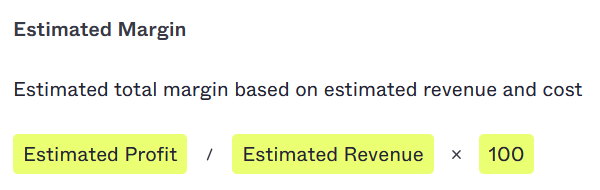
Actual Margin
Remaining Work Margin
Projected Total Margin
Expenses in revenue calculations
Expenses referenced in T&M calculations are defined as follows:
- Estimated Expenses: Expenses included in a project's scope.
- Future Expenses: Estimated expenses dated ahead of the current date.
- Past Expenses: Actual expenses dated prior to the current date.
Comments
0 comments
Article is closed for comments.